My travel companion is certain: this is the first time in our lives that we will see wild chimpanzees. He has arranged a meet-up with a conservationist called Matthew, who has been recommended to us by several wildlife specialists. When we near “his” Kigaju Chimpanzee Forest, Matthew gives us a call: he will be slightly late, because of the burial of his father.
That’s not keeping us from going into the forest, as Matthew’s colleague Innocent is already waiting for us in a small plot that has seen better days. Our driver Emma (short for Emmanuel) leaves us to get some fuel in a nearby village. Innocent explains that there is a 97.7 percent chance that we will see our ‘closest relatives’ today. Normally, people hike for about two hours and most of the time, they will see chimps, he says.

The shy Innocent takes us through a field that leads to the entrance of Kigaju Forest. Before we enter the forest, he warns us about safari ants: if we don’t tuck our trousers into our socks, we will have the biting little insects all over our bodies, giving us painful little nibbles. He then points at the trees around us, which are lined along the edge of the forest. Matthew planted mangoes, jackfruit and sugarcane here to keep the chimpanzees content and inside his grounds.
We take the Royal Iguru Trail into the 46-acre large forest. We trudge through muddy paths, looking at nearly every tree, and although we do spot some baboons and squirrels, there is no sight of any chimpanzees – we can’t even hear any sound that suggests that the animals are nearby. According to Innocent, the only thing that points to the existence of the animals are the nests that are built high up in the trees.
Strangely, we haven’t seen or heard anything and forest owner Matthew agrees when we meet him after a four-hour hike. Especially in the morning, he says, the animals can usually be spotted. We now have to decide if we can come back later on, or if we will head on with our Uganda road trip. We decide to keep to our schedule and get back to the car. When we walk out of the forest gate, a sign says: ‘If you have not seen me, I have missed you!’
Our driver Emma, who is back from the village, tells us that someone at the fuel station has told him that there are no chimpanzees in the forest at all, but we don’t want to believe the rumours. We decide that before we get to Bwindi, we have to stop at another forest, to see if we can find the elusive chimpanzees.

And so we arrive at Kalinzu Forest Reserve, which is located between Rutoto and Ishaka, to yet again try our chimp trekking luck. On arrival, our guide Franklin promises us a 98 percent chance of seeing chimpanzees. That should make us optimistic, but we’ve heard that phrase before…
The forest is quite thick, but the pathways are clear and our walk into the Kalinzu Forest feels like a stroll in the park. At 40 USD, the entry fee at Kalinzu is significantly lower than the more popular chimpanzee forests of Kibale, where a ticket costs 110 USD. Another perk is that the reserve is less than an hour’s drive from the entrance gate of the majestic Queen Elizabeth National Park, so a chimp visit can easily be combined with a safari.
Franklin starts explaining about the chimpanzees, who she and her colleagues have given names. But then she stops, mid-sentence. “Did you hear that?” To be honest, we did not hear anything but get super excited when she says, “Those were the sounds of chimpanzees. Let’s go this way.” Then, she continues her story: “We name the chimps as soon as they make 12. By then, you can see recognisable features on their skin, fur and face.”

We are now walking as fast as we did during our first chimp trek morning in Kigaju – this will be our chance to spot some of Kalinzu’s chimp inhabitants! Franklin tells us that Kalinzu is not only the home base for over 220 Chimpanzees, but that there are also over 350 different species of birds flying around us and that sometimes, one can even spot a leopard. “Around seventy of the chimps have been habituated by Japanese researchers, which means that they are used to human visitors.”
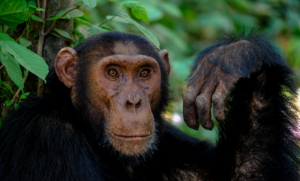
After a twenty-minute walk and several phone calls with other trackers in the forest, Franklin points up one of the many gigantic trees. “That’s Victor,” she says. Victor is comfortable, high up in the tree, but is constantly looking at his wazungu visitors. It’s hard to take a good picture of the chimp, and after a short while, we are surrounded by other visitors. Although Victor will be the only chimpanzee we see during our two chimp treks, we are thrilled – how many times in a lifetime can one meet our ‘closest relatives’ in the wild?!
Words by Joost Bastmeijer. Follow him on Instagram: @joostbastmeijer