Ng’aali’s Adele Cutler met with Conservationist Holly Budge after her trip to Zimbabwe where she joined the ladies of Akashinga, an armed all-female anti-poaching team protecting the country’s most iconic wildlife.
Holly Budge, founder of the charity How Many Elephants, earned the rare privilege of accompanying the highly skilled Akashinga rangers whilst they patrolled Zimbabwe’s Phundundu Wildlife Area, an 115-square-mile former trophy hunting region in the Zambezi Valley ecosystem. This area has lost thousands of elephants to poachers over the last two decades. From the summit of Everest to the frontline of conservation in the African bush, Holly is no stranger to adventure, but this was a whole different beast.

“It was 5:45am and I was standing in line with four armed Akashinga rangers, ready to go out on foot patrol. ‘You may not see any wildlife Holly, this is not a safari trip,’ said Nyaradzo. I pinched myself as the realisation of what I was about to do became real. These women were fighting a war on poaching and the poachers were not the only threat out there. As the rangers loaded their rifles, the front one clicked her fingers as a signal to go and I took a deep breath as we moved into the darkness,” she recounts her ordeal with the Akashinga.
Akashinga translates to “the brave ones” in the local language, an apt name for the often dangerous work they do. Coming face to face with poachers and wild beasts, heading raids and sting operations, these women are highly trained and highly motivated to make a difference to the future survival of endangered African wildlife species.
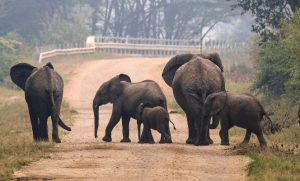
Holly has a mission to raise awareness of the African elephant crisis and make a difference. Every day, 96 elephants are killed for their ivory – that is over 35,000 of these magnificent, gentle, intelligent animals a year. That’s just ten years to extinction.
Holly spent several days immersed with the Akashinga Rangers, accompanying them on their daily patrols and other duties. Make no mistake though, this is not a 9-5 job and no day is the same. These women work 14 days and take 10 days off in-between. They are not only changing the face of conservation but the traditional status quo of women staying at home and bringing up children. They are the breadwinners and positive role models in their families, their communities and beyond.
“That day, as we moved further into the interior, the realisation that these women were my lifeline dawned on me. Without them, I was a dead woman! This was a war zone and we were patrolling on the frontlines. Challenges presented themselves at every corner. Wild and dangerous beasts roaming, snare wire coiled around trees like spider webs awaited their prey, the thorny undergrowth, the stifling heat of the sun, the desperate lack of water and signs of poachers’ presence all made this a very hostile environment to be in, especially for a newcomer. “Welcome to the bush Holly,” one of the rangers whispered to me.
“By moving men into construction and labour and putting women in the power roles of law enforcement, management and decision making, we’ve completely de-escalated the majority of local tension and brought conservation and communities together, ” said Damien Mander, founder of Akashinga. Damien strongly believes that the face of conservation going forward is female.
Holly remembers driving through the local communities with Nyaradzo, her go-to ranger, as all heads turned. Nyaradzo told her that the men in her community had instilled in them the belief that women couldn’t drive big vehicles. Nyaradzo proved them wrong when she learnt to drive through the ranger programme, and her pride spilled over each time she drove the 4×4 anti-poaching vehicle around the communities as part of her daily work.
This was not Holly’s first time on the frontline, having spent time immersed with The Black Mambas in South Africa, another all-female anti-poaching team. “These are two very different female ranger models. The Black Mambas are armed with only pepper spray and handcuffs. The Akashinga are armed with rifles and trained in combat. But both are making a tremendous impact on the ground in Africa,” said Damien.
Holly uses her world record adventures, including being the first woman to skydive Everest to raise awareness of the African elephant crisis and raise charitable funds for her charity. To-date, she has fundraised over £350,000. Her hard-hitting campaignuses design as a powerful visualisation tool to bridge the gap between scientific data and human connection. Her travelling exhibition showcases 35,000 elephant silhouettes to show the sheer scale of the elephant poaching crisis.
The thought of the African savannah devoid of elephants is heartbreaking enough but putting emotion aside, the impacts of losing these animals will be of extreme detriment to the environment and beyond. If elephants go extinct, entire ecosystems could follow as they are a keystone species and are important ecosystem engineers.
Holly helped to dismantle snares wrapped around shady trees, waiting for their victims to take shade from the beating sun. “It was heartbreaking to try and comprehend how many snares were out there and how quickly they were replaced once found and removed. It is an ongoing battle,” she says.
Holly is calling all conservationists, scientists, politicians, educators, storytellers, adventurers and change makers who can dare to say, ‘I can make a difference in the world’. It’s time to stand up for elephants, before it’s too late.
For more information on Holly’s charity, visit www.howmanyelephants.co