Barkcloth was once worn throughout southern Uganda by people of all classes. This ancient craft, an endangered tradition on UNESCO’s Intangible Cultural Heritage list, is now making a revival in the face of some very unusual prejudices.
Words and photos by Mark Eveleigh
Paul Bukenya Katamiira is sighting up the length of a tree trunk with all the concentration of a professional snooker player lining up a particularly crucial shot.
“It’s vital that the first incision should be perfectly straight, right down the side of the tree that catches the most rain,” he says as he slides the tip of his knife into the trunk. Milky sap oozes from the sliced trunk and beads of sweat appear on Katamiira’s forehead as he eases his blade cautiously down the trunk. The outer layer of bark has already been shaved with the panga (machete) and a long-handled tool known as. This is the preliminary step in an incredibly complex process that can span 40 stages before the barkcloth is finished. In 2005, the art of Ugandan barkcloth production was recognised by UNESCO as a disappearing part of humanity’s intangible cultural heritage, and 60-year-old Katamiira is the direct descendent of nine generations of master craftsmen.

The selection of an ideal tree is the crucial first step in a tradition that dates back more than 600 years. The species of fig used is known locally as mutuba (Ficus Natalensis or Natal fig), but Katamiira and his workmates recognise no less than 13 varieties of mutuba, each providing barkcloth that has different properties.
“We call this type of tree, but the best barkcloth — the Rolls Royce of barkcloth — comes from a tree we call,” says Vincent Kajoga, Katamiira’s brother.
While Katamiira has produced barkcloth for almost half a century, Kajoga was forced to abandon his vocation to search for work in Kampala, but has recently returned from Uganda’s capital. Bukomansimbi Organic Tree Farmers Association (BOTFA) has given these men and others in the community of Kibinge (Southern Uganda) a fresh opportunity to make a living from their barkcloth know-how.
Katamiira and Kajoga work quickly and efficiently to minimise stress to the tree, easing the precious inner bark away with a banana-wood wedge. Scouring the inside of the tree with iron at this stage would create scars. The softest barkcloth comes from a tree that is harvested annually. If it’s done carefully, a tree can be harvested for 40 consecutive years. After the inner bark has been eased off, the denuded trunk must be protected by massaging the sap back in and covering any damaged sections with cow dung. The trunk is then wrapped with aging banana leaves for a week to accelerate healing. Fresh green leaves are not used because they would inhibit air circulation.
“The creation of Ugandan barkcloth is said to date back to one man,” says artist Fred Kato Mutebi, BOTFA’s founder. “About 600 years ago, a Buganda king ordered a hunter called Lule Ssonko, from the otter clan, to teach the art to others. Barkcloth became part of royal ceremonies but was also adopted for everyday wear by Ugandan people and eventually became a trade item of Africa’s Great Lakes region.”

Historically, two things caused the demise of the barkcloth industry: in the 1850s, Arab traders and slave traders came with brightly coloured cotton fabrics that quickly supplanted the tan-coloured barkcloth and in 1875, British missionaries arrived, driven by a sacred urge to suppress anything that they considered ‘ungodly’.
“Because barkcloth was used in traditional ceremonies, the missionaries labelled it satanic,” Mutebi explains. “Our traditional cloth became demonised to the extent that only a few God-fearing Christians could wear it, with the support of kings, at royal ceremonies.”
Some Ugandans associate barkcloth with death and witchcraft. It’s extremely unlikely that anyone would wear barkcloth at village level. To do so would be to incite suspicion that you might be a witch, a traditional healer or a nightdancer – which is our term for a cannibal,” says Katamiira.
The production of barkcloth is common among communities right across the tropics. In the Alor Islands of Indonesia, the Kabola tribe still wear outfits made from what is literally tree-skin and, on New Guinea Island, bark-string bags (also on UNESCO’s intangible heritage list) are an everyday accessory.
We’re squatting in the lean-to workshop on the little homestead where Katamiira’s forefathers settled almost 300 years ago and the men are preparing for the final stages of producing cloth from the roll of bark that they’ve carried back from the forest. The roll must be boiled for a few minutes to remove the sap.
“When people are preparing barkcloth for funerals, they’re reluctant to go through all the extra hours of pounding and softening that are essential if you want to make really fine cloth,” Katamiira tells me as his five-year-old grandson sits by wielding a heavy mallet. Known as, these mallets (weighing up to 3kg) are carved from a solid trunk of a forest tree known as and the logs must be buried for at least three months in order to dry them. The mallets will last for decades if, when not in use, they’re wrapped in barkcloth to prevent them from cracking. Katamiira shows me a mallet that was used by his grandfather: “Most workers only have two mallets but we use a set of four, going from heavily ridged edges down to completely smooth.”
Katamiira starts hammering all afternoon, and until the equatorial sun has plummeted swiftly onto the horizon, the dull thud of his mallet echoes out of the lean-to. He hammers all the next day too until the sheet of bark has been beaten through at least 30 times and is almost paper thin – by now it has expanded to five times what it measured when it was cut from the trunk. The final stage is to dry the cloth in the sun and this might only take about two hours but sometimes the workers might decide on a longer ‘tanning’ time. Prolonged access to the sun produces a rich tan colour that is reminiscent of the hide of the revered long-horn cattle or even of the red African soil itself. Occasionally, Katamiira produces rare black barkcloth, dyed using time-proven tradition that is now almost forgotten.
“There are probably only a few people who still know how to do this,” says Mutebi one morning as we follow Katamiira to the edge of the papyrus swamp that has been used for this purpose for centuries. Katamiira squats on the bank and sifts his fingers through the mud, feeling for just the right consistency of clay. The dye in the mud starts to stain the barkcloth the moment it is submerged but Katamiira knows that the cloth must be buried for three days to be permanently dyed black. (Mutebi has experimented extensively and, bizarrely, the dye does not seem to work with other fabrics.)
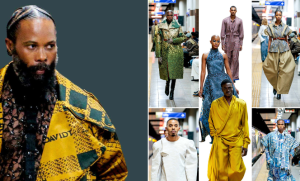
This black barkcloth – sometimes used to decorate shrines in black magic – is now used almost exclusively in the interior design and fashion worlds. Katamiira and his co-workers at BOTFA are now selling most of their superior quality barkcloth to artists and designers who create items that are turning heads all over the world.
Ugandan designer José Hendo (josehendo.com) describes herself as an eco-sustainable fashion designer who uses barkcloth in her avantgarde designs.
“I’ve been using barkcloth as my primary material for more than 15 years, and have produced more than 200 creations that have been shown on catwalks and exhibitions from Los Angeles to London to Stockholm,” she says. In 2014, Hendo set up the Barkcloth to the Roots initiative (B2TR) and, in collaboration with the Uganda Museum and BOFTA, recently launched a campaign to plant one million trees.
While she focuses on the international fashion scene, Hendo acknowledges that within the country, the industry faces a challenge to ‘take the darkness out of barkcloth’. Barkcloth is finally starting to broach the boundaries of coffin shops and funeral parlours and a multitude of potential uses are now being developed. Pulped off-cuts are being used to create designer paper and the Uganda Industrial Research Institute is investigating the potential to use it to make affordable, biodegradable sanitary pads.
Traditionally, the tree has been a valuable commodity. Apart from the bark and wood (for building), every part of the tree can be used: the young aerial roots counteract high blood-pressure; the sap (when mixed with water) is said to be an aphrodisiac; and the leaves and outer bark are gathered for animal fodder. In contrast to eucalyptus, which is thirstily desiccating and poisoning the wetlands, the tree is able to raise the water table and barkcloth advocates say it could be a vital agent in the fight against climate change. It seems that the struggle to reboot this ancient tradition is even more important than most people imagined. ‘Mutuba tree, bridging communities, nurturing the environment,’ reads a slogan on the wall of Kibinge Village Primary School. The once ubiquitous tree could well turn out to be an answer to many of Uganda’s economic, social and environmental problems.