Words by Daniel Butare
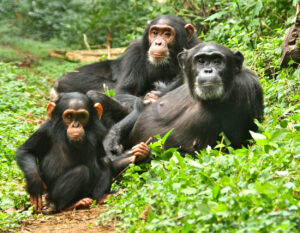
In the heart of the Democratic Republic of Congo’s Salonga National Park, Africa’s largest tropical rainforest reserve, a small team of researchers and trackers continue to rewrite the future of our closest living relatives through a gruelling, long-term endeavour: the habituation of wild bonobos.
When WWF and Chengeta Wildlife initiated the targeted Bonobo Habituation Programme in late 2023, the bonobos lived in a state of constant vigilance. Initially, any detection of a human meant immediate panic, vocal warnings, and rapid flight through the trees. Earning the trust of a wild bonobo takes ages.
For a species heavily impacted by decades of poaching and habitat fragmentation, learning that humans can mean safety rather than slaughter is a monumental cognitive shift. That means showing up day after day in the same calm, non-threatening way until the animals begin to accept people as part of their environment rather than as a danger.
The process of habituation does not begin in a laboratory, but in the pitch-black, suffocating humidity of the jungle floor. Every morning, long before the first shafts of light pierce the canopy, teams of trackers mobilize at 3am. The team must trek through dense undergrowth to reach the exact location where the bonobos built their woven tree nests the previous evening.
According to Park Co-Director, Terence Fuh, the goal is critical: arrive before the bonobos wake up. If the primates open their eyes to find humans already standing quietly below them, rather than stumbling aggressively upon them mid-day, their stress response is dramatically lowered. Among these trackers are local community members, including former poachers. Their intimate, generational knowledge of the forest’s geography, sounds, and paths has been transformed into an invaluable asset for conservation.
Researchers say the effort has already started to pay off. The bonobos now tolerate limited human presence, and in some cases, allow observers to watch them for hours at a time. That may sound like a modest breakthrough, but in the world of wildlife research and conservation, it is a significant one.
Habituation opens the door to better understanding of their behaviour, social structure and health — data that can support stronger protection for a species that remains under pressure from habitat loss and hunting.
It also carries a bigger ambition: ecotourism. If the bonobos can become comfortable enough around people, carefully managed visits could one day help bring travellers to this remote corner of Congo and create new incentives to protect the forest. For Salonga, that would mean conservation with an economic dimension — a way of linking wildlife protection with local livelihoods and sustainable travel.
Still, the process is delicate. Too much pressure, too much noise, or too much inconsistency can undo months of progress. The latest multi-decade data reveals a glimmer of hope: Salonga holds a critical stronghold of 12,000 to 18,000 bonobos across its massive landscape. Yet, they remain endangered, slow to reproduce, and completely confined to the south side of the Congo River.
The fact that researchers can now sit quietly under a canopy for hours while wild bonobos casually feed and rest above them is a testament to what patience can achieve. The road to trust in Salonga is long, measured not in kilometres, but in the quiet, synchronised heartbeats of two species learning to share the forest in peace.